The Paper Project – Experiment II

We’ve made it to the second experiment in The Paper Project! For this test I used the little fairy stamp from The Greeting Farm in a set called Neverland.

Experiment II – Basic Coloring

The purpose of this experiment is to simply color the image with minimal blending to see how quick layer of color would apply. (A blending test will be done later on.) Each image was stamped with Memento Tuxedo Black Ink then left to air dry for several days.

I used the same colors and applied one color at a time – meaning, I colored all the fairies’ wings with B21 then went back and added V12 to each wing before moving onto the next color. I used the same brush strokes for each image as much as possible.

Here are the Copic Marker colors I used:
-wings: B21, V12
-hair: Y21, Y26
-face: E000, E11, R12
-dress: R43, R46, R59

The papers are identified in the Introduction and here are the results:
(Click on the picture for a zoomed look.)

From the start I could see there was a difference when I stamped each image. In general, the black was the same, however, it is bolder on C, J, M, and X; and yet the lightest on D and E.

Also the intensity of the colors varied and some papers made the hues darker or lighter. For example, the colors on D, E, N and U are washed out yet they show up the darkest on B, I, K, S, W, and X.

There wasn’t any obvious problems with any of them but based on this experiment I would say A, B, C, F, G, H, I, J, K, L, M, O, P, Q, R, S, T, V, W, and X are the better papers to work with.

Tips, Tricks & Techniques 0x021

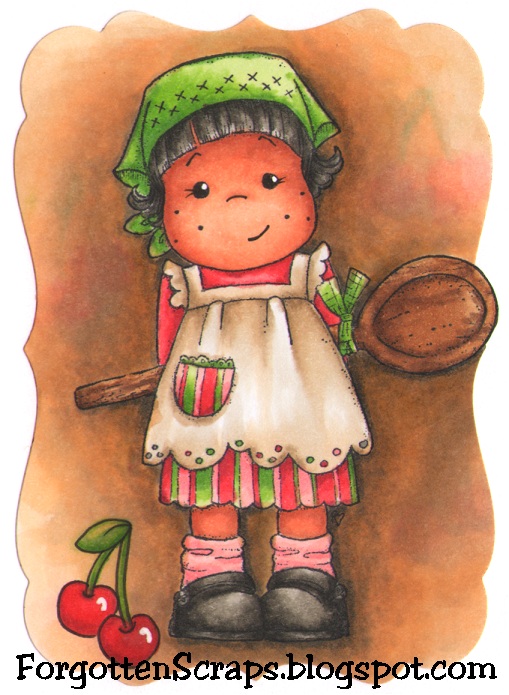
I don’t have a card yet but I did want to share the technique I tried out on this background below. First of all my tip is to get in the habit of opening up your Copic markers on the side of your project instead of over it. I had refilled one of my markers too much and discovered this tip the hard way on another image when two giant blue ink drops splattered on my nearly finished project! Anyway, back to the background technique – here’s the image first:


I wanted to create a rich earthy backdrop like I would see in a studio photograph. To do this I used over dozen different colors and kept building it up, layer upon layer, color upon color. When I started it would dry out in between colors but towards the end the paper stayed wet and allowed me to push and blend the colors more freely. I started with a couple spots in red and green (G24, R24) and then added browns (E40, E41, E42, E43, E50, E51, E53). Most of the red and green areas were “washed out” so next time I’ll add more. Once the browns were built up I went back in with Toner Gray (T0, T2, T4) and used the lighter browns to help blend it. Each color was added several times and worked through until I liked what I saw. If you give it a try I hope it works out – Good luck!

The Paper Project – Experiment I

Welcome to the first experiment of The Paper Project! After punching and labeling over 650 small squares I wanted to work on an easy test – one that require no coloring! Hope you enjoy…

Experiment I – Ink Drop

One droplet of Copic Various Ink Refill G29 Pine Tree Green was dropped at a distance of approximately 1.5 inches high then allowed to dry. I wanted to discover how each drop was absorbed into the paper. (You can click on the image to enlarge it.) The ink was then given 4 hours to dry before I tested for smudging. Each sample was rubbed with a dry finger to see if any of the ink would smear.

Each of the samples was assigned a random letter and the master list can be found on the Introduction page. Even though all of the samples are considered white, you can see that they vary in color including some reds and blues.

I noticed that A has the smallest diameter; it appeared the droplet exceeded its saturation level and the remaining ink pooled and dried on the top.

B, C, N and U have irregular circumferences; it appears the droplet spread across the surface before seeping into the paper.

D, E and (to a smaller degree) S are lighter in color; somehow the depth of the color is lost. In addition, these count for three out of four of the shimmering papers.

As far as I can tell, the edges on A, G, J, L, M and O indicate the droplet was absorbed and spread through the middle layer of the paper first.

On most of the samples, the ink shows through to the back side of the paper. However G, H, I, K, and L all seeped through onto the next sheet of paper and that N didn’t show up on the back side at all.

After letting the sample dry for several days I tested for smudges by rubbing my finger over the dried ink drop and found that A, B, C, I, L and M had smeared.

This was a difficult call because the results varied so much, but based on this test alone I would recommend the following papers to be desirable: D, E, F, G, H, J, K, O, P, Q, R, S, T, V, W and X.

The Paper Project – Introduction

I’m sure there are many paper projects but this one is specific to testing Copic markers on the various papers available. Like most of you, I started on a quest to find the best paper to color on. Therefore, I hope to perform various experiments on each brand to see how they measure up. If you want to follow along, feel free to grab the Badge from the sidebar and display in on your blog!

Welcome to the Paper Project!

With the help of a few friends, I’ve gathered several different papers so far to test on. Sending out a huge thank you to Annika, Beccy, Donna, Peggy, Ruby, Vicky and Zoe for building my paper supplies. *Thanks!*  Below is the list of papers that I’m working with.

  1. Stamping Bella‘s Bestest Paper White
  2. Copic Beedproof Markerpad 70g/m2
  3. Stampin’ Up! Whisper White Card Stock 80#
  4. Bright White Shimmer Card available in UK (heat emboss image)
  5. another pearlescent (textured, heat emboss image)
  6. Papermill Super Smooth Bright White Card 300 gsm (140#)
  7. Daler Rowney Bristol Board* available in UK
  8. Bristol Board* #2
  9. Rey Printer Card Paper 160 gsm
  10. Xerox Colotech Paper 250 gsm
  11. Georgia-Pacific Copy & Print Paper 20# (standard printer paper)
  12. Neenah Solar White Super Smooth Crest 80#
  13. Curious Metallic Cryogen White Card Stock 89#
  14. Gina K. Pure Luxury Card Stock Pure White 120#
  15. Neenah Solar White Smooth Crest 80#
  16. X-Press It Blending Card Bright White 92#
  17. Make ‘it’ Colour Blending Card 250 gsm
  18. Georgia-Pacific White Card Stock 110#
  19. Stampin’ Up! Shimmery White Card Stock 80#
  20. Copic Papercrafting Stamping Paper – Natural White
  21. Bee Paper Company Heavyweight Marker Paper 110#
  22. Beckett Card Stock Radiance 80#
  23. Q-Connect White Wove 100g
  24. Hammermill Color Copy 80# Photo White

*Bristol board (also referred to as Bristol paper) is an uncoated, machine-finished paperboard. It is named after the city of Bristol in the southwest of England. It provides two working surfaces, front and back. This quality separates it from illustration board, which has only a front working surface.

Each brand was assigned a random letter to keep track of them during the testing. Testing will be done on an irregular bases but I you can find them under the tutorials label to each post so they’ll be easy to find. Here are also some quick links to the experiments:

  1. Ink Drop
  2. Basic Coloring
  3. Blending Out Colors
  4. Paper Attributes
  5. Blending Red
  6. Blending Added Depth
  7. Paper Purities
  8. Transparency
  9. UV Rays
  10. Paper Comparisons
  11. Marvy Le Plume Alcohol Markers

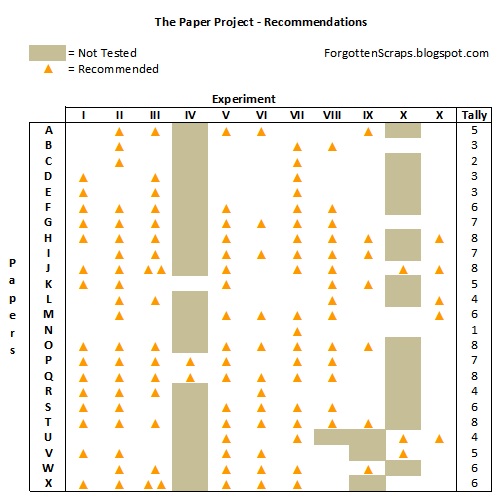
When all of the papers are tested together in the same experiment then after looking at the results I recommend the best papers. This recommendation is based on that test only so a specific paper may go in and out of favor. Below is sort of a chart that shows how many times each paper was recommended and is indicated by a triangle. Of course the more triangles listed the better the paper has performed overall.

On two of these tests I show that we can achieve amazing results by altering our techniques to fit the paper attributes. (See Experiments IV and X.)  Thus this rating of recommendation gives an overall indication of which papers are more durable and suited for a higher variety of techniques and skills.

I hope you’ve enjoyed The Paper Project and I will continue to update these posts as I get more information. Until then… happy coloring!!

(Last updated on August 11, 2013.)

Tips, Tricks & Techniques 0x020

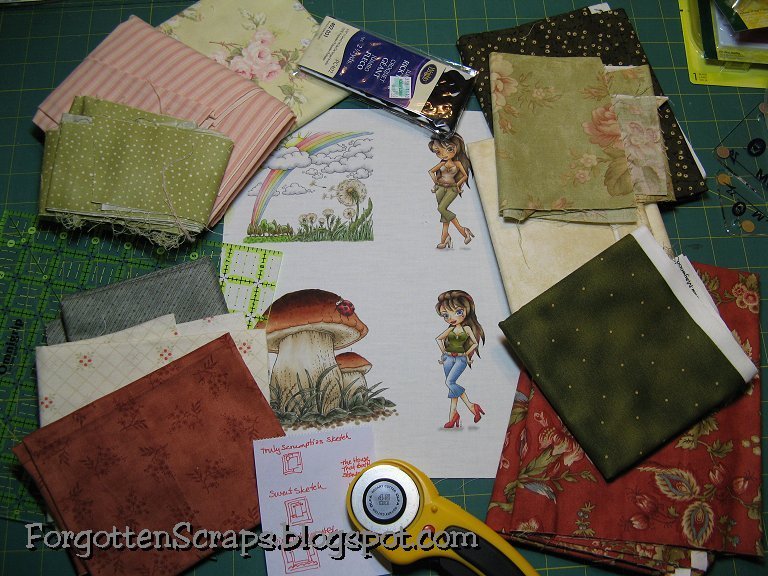
For today’s Tips, Tricks & Techniques I have a sewing tutorial… yes, I said sewing. ;D One of my challenges a while ago was to color on something other than paper and I chose to do fabric. The whole time I was asking myself, how do emphasize this was colored on fabric? I tried to think of the many ways I could incorporate other fabrics onto a card but still didn’t think it would stand out. I finally decided I had to sew something… and what would be better than another bag? He he he. So today I’m going to walk you through making these simple bags!


This will be a 12-step program, and if you take it one step at a time, I’m sure you’ll make it to the end. 😀 Just click on the images below to zoom to that step or scroll down the post to catch them all. If you want to learn more about sewing, head on over to Grandma’s Pearl for some quilting lessons. She’s starting at the basics and will help you through to a finished quilt! Plus there is loads of information throughout that can be used by any seamstress.

One Two Three
Four Five Six
Seven Eight Nine
Ten Eleven Twelve
All these images are from Make it Crafty and were printed onto EQ Printables Inject Fabric Sheets. You can check out these other posts for details and tips on coloring the fabric with Copic Markers: Geeky Love and Make it Colourful:Colouring on Material.

I always like to select my papers first, in this case fabrics, before I coloring the images. This way I can match up the image with the colors in the fabric. I selected one background fabric, which will be used for the bag, plus two accent colors.

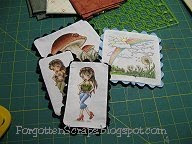
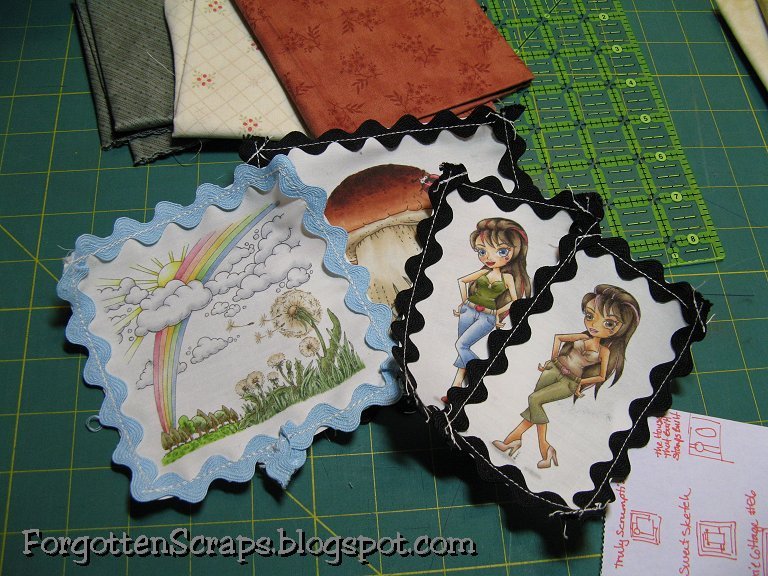
I then cut out the images leaving enough white space around the border so I could sew ricrac around the edges. Printing four images per sheet gave me just enough room to do this.

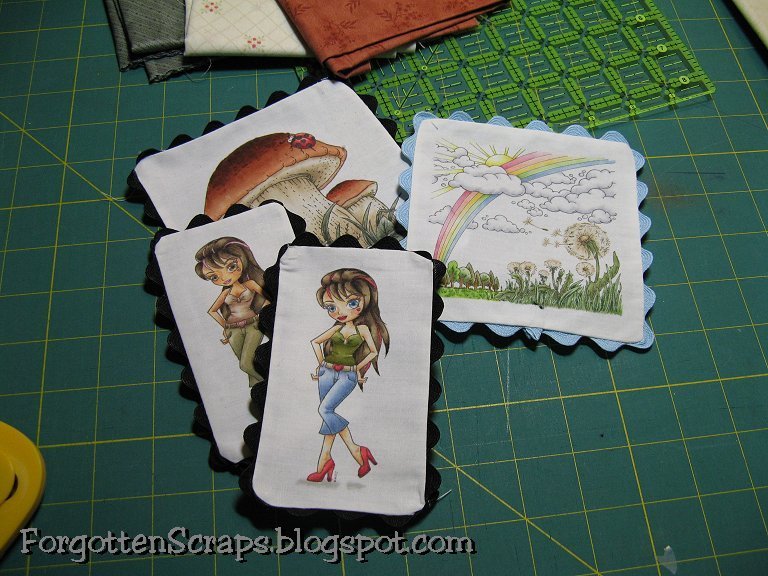
There are different ways to finish the edges, but for my bags I decided to sew ricrac around the edges. Ricrac can fray easily so make sure the ends will be secured somehow, either through sewing or with Fray Check. I sewed the ricrac on the top with approximately 1/4″ seam allowance.

In this next step I pressed the ricrac around to the back with a hot iron. Through experimenting, I found that the heat doesn’t ruin the Copic markers so I was able to iron it without any problems. There was a faint odor present so I didn’t leave the iron on it too long.

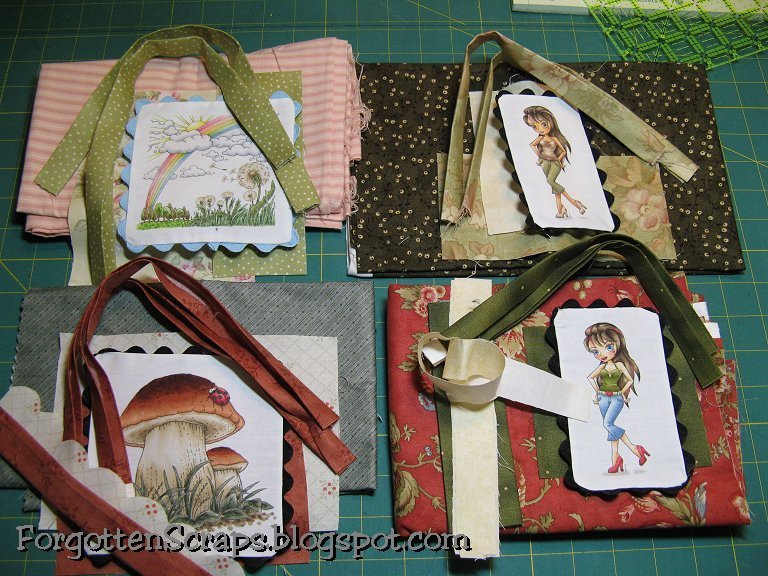
After I had my center pieces finished, I use the “flinch” method to cut out my accent colors. I treated these the same way I would a card and found a fun sketch to follow. Then I cut the strips and squares to the approximate size I thought they should be, sometimes cutting a little more here or there until I liked the result. (Sketches are listed below with the details.) I planned to keep most of the edges raw so they would fray and therefore didn’t need to worry about a seam allowance. The bags were also cut at this time including a Muslin fabric lining that will be the same size. Basically figure out what size bag you want and double the width – then add 1-2″ to the length and width for a cutting size.
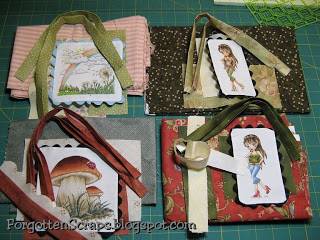
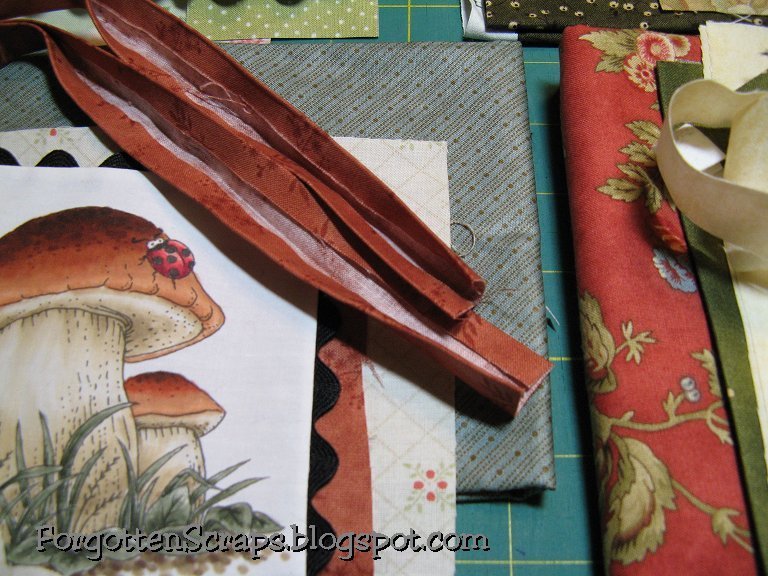
For each bag I cut two extra long strips, about 2.5″ wide, which will be used for the handles. How long you might ask? Well, if you like long handles then cut them longer, and if you like short handles then cut them shorter. ;D But you probably don’t want to cut them any shorter than 10″ long. I then pressed each of the handles in half, tucking in the edges, so when I sewed down the long side, the raw edges would hidden.
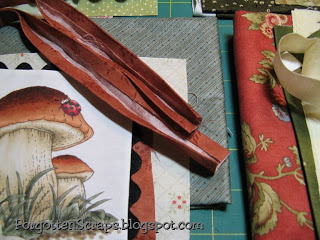
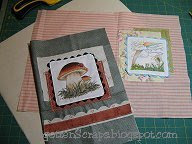
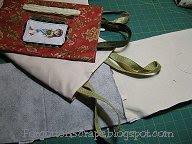
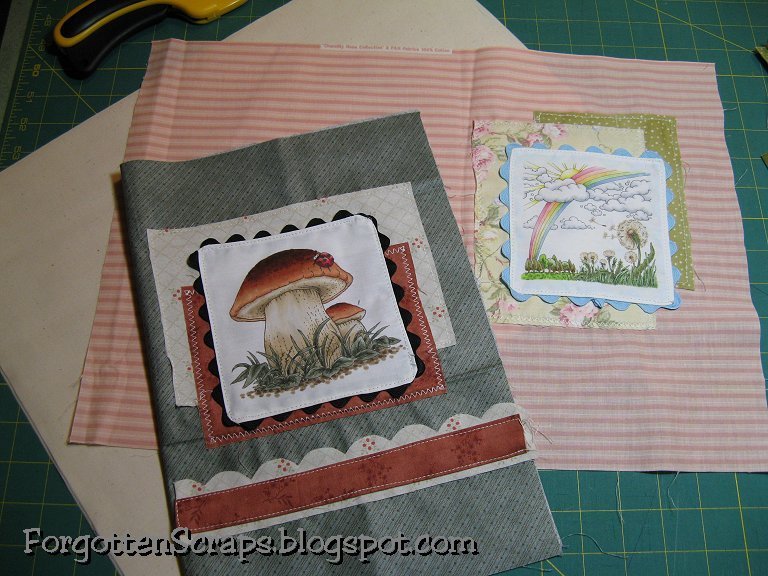
The next step was to sew on all the elements to the bag, the front part only. To get the positioning right, I folded the fabric first to layout the elements then pinned them down so they wouldn’t move. If this is too tricky, you can also use iron-on transfer paper. Starting with the back layer, I sewed most of my elements on with a straight-stitch or a zig-zag. Make sure that you only sew on the top layer of the front bag. 😀
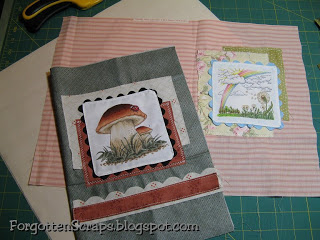
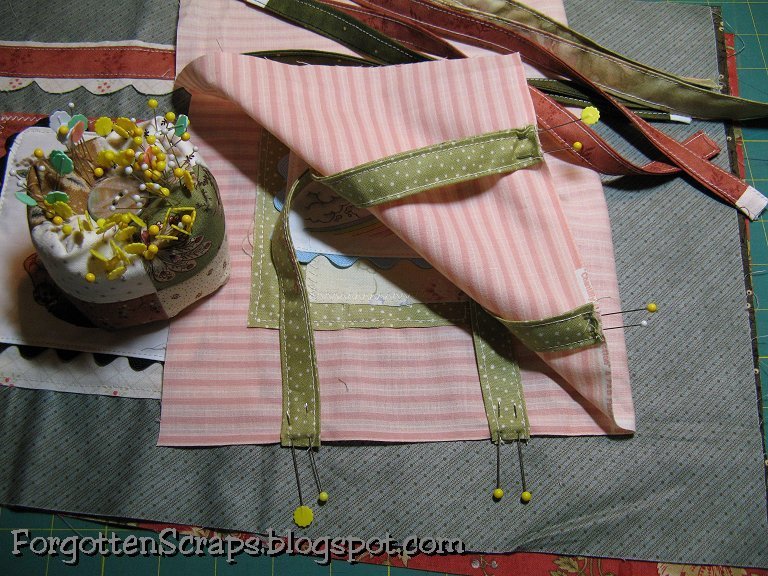
The handles were stitched on both sides lengthwise and because I pressed them like bias tape, there was no need to turn them inside out. I then pinned the straps onto the top. With the bag folded again I’m able to line them up. Remember to shift the handles slightly towards the folded side to compensate for the seam allowance on the other side.
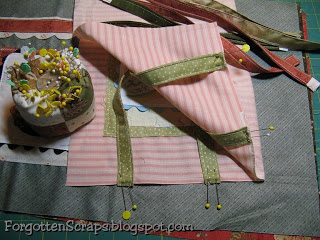
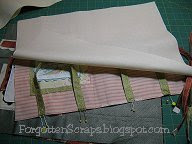
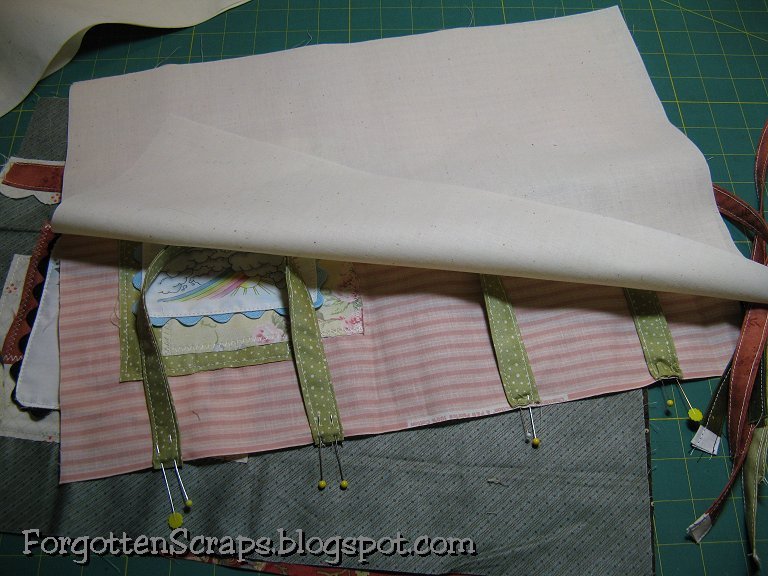
Here’s a better view of how the straps are pinned onto the top. I then covered the front of the bag wit the Muslin fabric, the liner, and stitched across the top only.
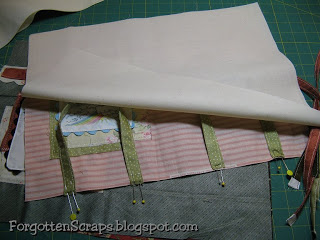
After stitching acrosss the top, I used the iron to press the seam, first with both layers flat then together as they would be finished. This is important and will help keep the top part of the bag straighter with the next few steps.

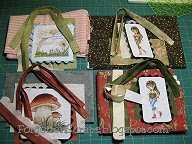
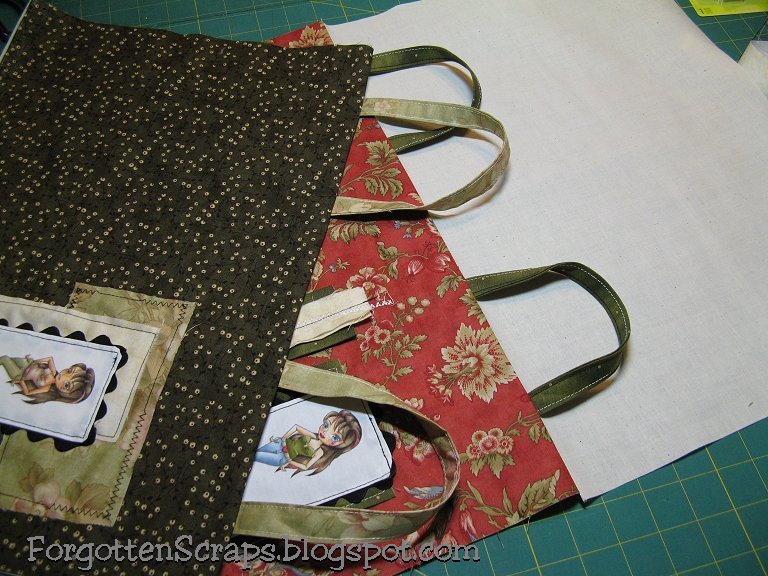
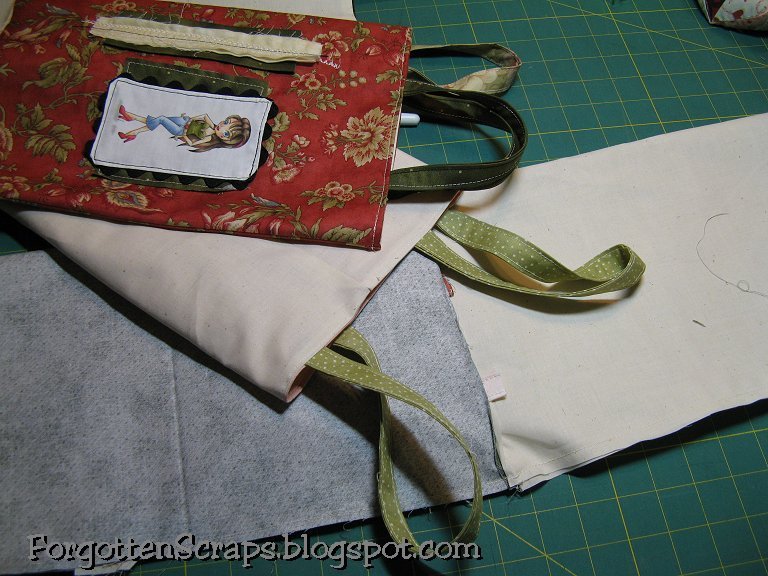
Are you still with me? We’re almost finished but the next two steps might be a little tricky so make sure you study the pictures well. With the top part of the bag sewn and pressed together, I unfolded it and refolded it the other way, lengthwise. This puts the same fabrics together with the handles on the inside. (See the bottom bag in the picture.) I then sewed down the side of the bag giving myself a slightly more generous seam allowance when sewing down the inside, the Muslin fabric. That way the inside of the bag will be just slightly smaller than the outside and will help minimize bunching. Be careful to not sew the ends of the bag, the parts that will be the bottom of the bag. If you want, when this step is finished, you can turn the bag right-side-out and top-stitch around the top. I find this helps reinforce the handles and also helps the form of the bag. (The red bag in the picture shows the top-stitch.)

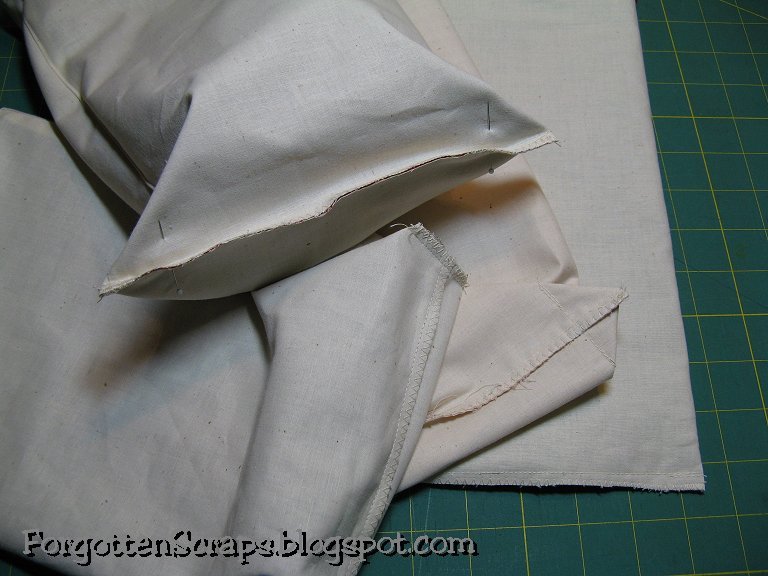
For the last step, the bag needs to be turned inside-out and use an iron to press it flat. With all four layers pressed together, sew across the bottom edge of the bag to close it up. Because this will be an expossed edge, I used a stright-stitch with a zig-zag but you can use a Serger sewing machine. (See the bottom bag in the picture.) At this point the bag is now a bag but I always like to tuck the corners to give it a bottom like most handbags are. To do this, open the bag and flatten the bottom slightly then pressed down the corners until they meet with the sides. I like to come up about 2″ from the corner’s tip and pin it. (See the top bag in the picture.) With the bottom and sides together, sew across it from side to side which will make a triangle flap on each side. You can cut this off and Serge the expossed edge, handstitch the corner to the side, or just leave it alone. (See the middle two bags in the picture.) I cut them off on one bag but left them alone on the other three.
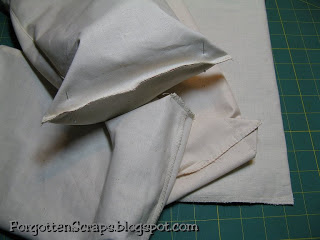
You did it – now turn the bag right-side-out and it’s finished! If you want, you can add other embellishments such as flowers, charms and ribbons just like you would a card or scrapbook page. These bags turned out to be the size of a coloring book and box of crayons, however, lots of other stuff can be added too!

Supplies Used

Here are the details on the stamps and the Copic colors used for each handbag. The thumbnails are really small so you can click on the pictures to view a larger image of the coloring details. If you have any questions, just leave me a comment and I’ll come back in and add the answers below this section. Enjoy and I hope you have fun making a bag or two! 😀

Main Stamp: Rainbow Dandelion (MiC)
Sketch: Truely Scrumptious – Challenge #50 (sketch)
Colored On: EQ Printables Inject Fabric Sheets.
Copic Colors:
-rainbow: R81, R83, R85, R000, R11, R12, Y000. Y11, Y23, G40, G82, B91, B93
-clouds/sun: C0, C1, Y000, Y11, Y23
-dandelions: E40, E41, E43, G40, G82, G85, YG91
-other: YG91, YG93, YG97, G40, G82, G85, YG97, YG93, YG91, E35, E37

Main Stamp: Violet (MiC)
Sketch: Sweet Sketch Wednesday – Challenge #88 (sketch)
Colored On: EQ Printables Inject Fabric Sheets.
Copic Colors:
-skin: E000, E00, E11, E13, R11
-hair: E41, E43, E44, E47, E49, R81, R83
-clothes: E40, E41, E42, E43, BG93, YG91, R81, R83

Main Stamp: Violet (MiC)
Sketch: The House That Stamps Build – What if? Wednesday #911 (sketch)
Colored On: EQ Printables Inject Fabric Sheets.
Copic Colors:
-skin: E000, E00, E11, R12
-hair: E42, E43, E44, E47, E49, R35, R37, R39
-clothes: R35, R37, R39, B91, B93, B95, B99, E40, E42, E43, YG93, YG95, YG97
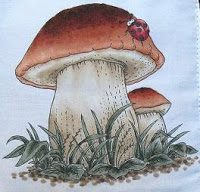
Main Stamp: Whimsical Mushroom (MiC)
Sketch: The Pixie Cottage – Challenge #56 (sketch)
Colored On: EQ Printables Inject Fabric Sheets.
Copic Colors:
-grass: BG93, BG96, BG99
-ground: E43, E44, E47
-mushroom: E40, E41, E42, E43, E11, E13, E08, E19, E18
-bug: R32, R35, R37, R39, W7

Questions Answered

A: I colored a test image and soaked the fabric in cold water but see any noticable bleeding of colors. The Copc colors used were G29, V17, B97, R46, Y17, E44, RV13, W10, C3 and E00.

Tips, Tricks & Techniques 0x01F

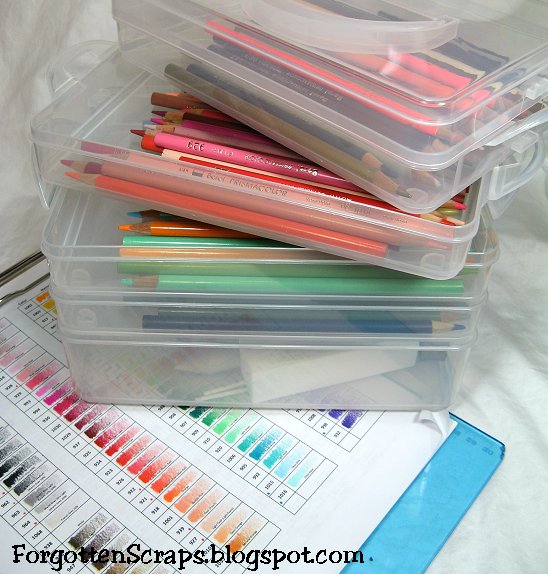
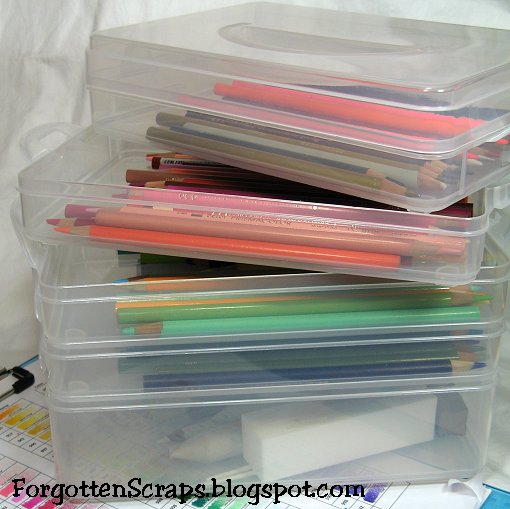
I’m always on the look out for great storage ideas but today I wanted to share an idea with you. I needed a way to store my Prismacolor Pencils because finding one color in the pile was too time consuming. I came across these containers at the hobby store (Michaels) and thought they would be perfect.


I created a specialized chart because my pencils are very old so there are a lot of retired colors and names that have changed. To do this, I arranged them all out on the table and fiddled with the rainbow until I was happy. Then I transferred the number order into a spreadsheet, printed it and finally colored it in.


The containers come with one large one and two smaller trays in a bundle. I combined two bundles and used four smaller trays for the pencils which correspond to each column in the color chart. Then I tacked on one of the large trays to carry around the extra equipment and other small items.

This also makes it easy to color on the go… just store a couple extra stamped sheets in the bottom tub then grab and go! I hope this gives you some ideas too and good luck!